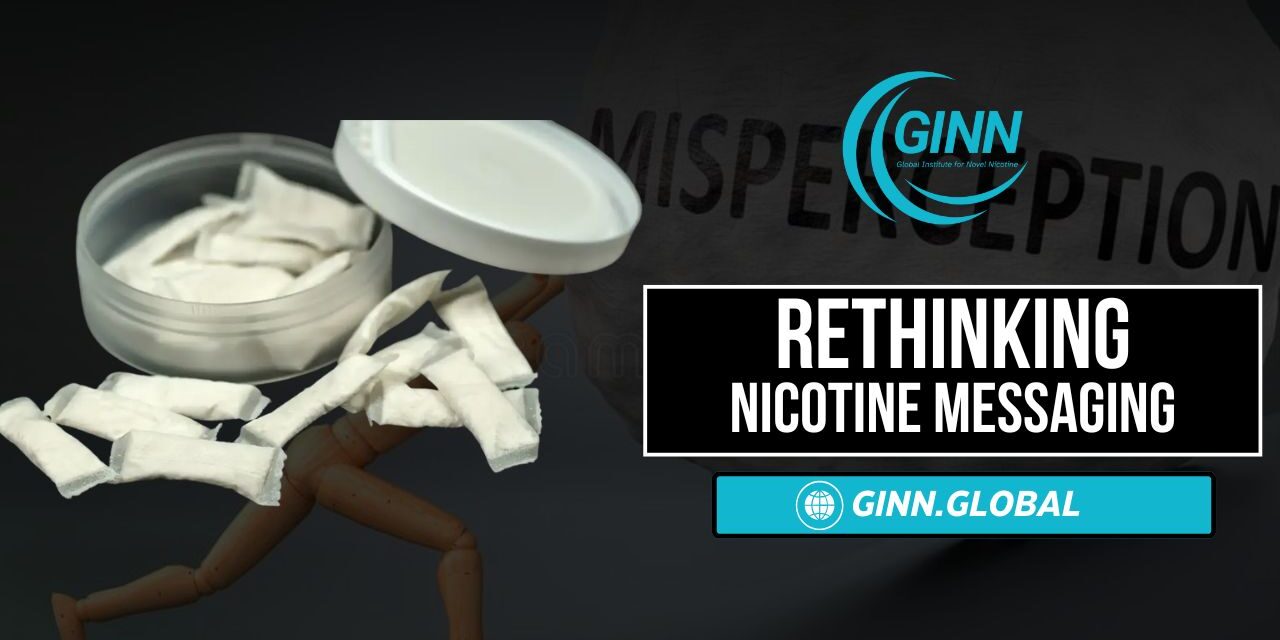
Public misunderstanding of nicotine remains a major obstacle to harm reduction, and the consequences are lethal. Despite decades of public health education about the dangers of smoking, many people still confuse nicotine with the primary causes of cancer and disease. But it’s not nicotine that causes lung cancer, emphysema, and heart disease, it’s the burning of tobacco.
A groundbreaking study led by researchers at the University of Pennsylvania’s Annenberg School for Communication and published in Science Advances reveals just how deep this confusion runs, and what can be done about it.
The Problem: Nicotine Blamed for the Wrong Harm
The study found that more than 60% of smokers still mistakenly believe that nicotine is the primary cause of cancer. This misperception is a critical barrier to switching to safer, smoke-free alternatives like nicotine pouches, vapes, or heated tobacco. If smokers think these alternatives are just as dangerous as cigarettes, they have little incentive to make the switch.
This is not a new problem, but one that persists even in highly educated populations. It’s also exacerbated by public messaging that focuses on nicotine addiction without clarifying that nicotine itself is not carcinogenic when consumed in a non-combustible form. This confusion can lead to poor policy decisions, such as over-regulating low-risk alternatives or restricting access in ways that favor continued cigarette use.
The Solution: Curiosity as a Communication Tool
The Penn researchers tested a range of public health messages to see which were most effective at correcting misconceptions. They found that traditional, fact-based corrections often failed to change beliefs and, in some cases, triggered defensiveness or resistance.
However, one strategy stood out: the “curiosity gap.” By framing corrective information as something surprising that people don’t know, e.g., “Many people are surprised to learn that nicotine itself is not the primary cause of cancer”, the researchers saw dramatically improved engagement. People clicked through to learn more, spent more time with the content, and were more likely to recall the correct information days later.
The curiosity-based approach doesn’t confront people with their error, it invites them to discover something new. This subtle shift can open the door to a more open mindset, particularly among groups that may distrust public health messaging.
Why This Matters for Harm Reduction
GINN believes that successful harm reduction strategies require more than just scientific accuracy, they require effective communication. Smokers who are misinformed about nicotine are less likely to quit, less likely to switch to lower-risk products, and more likely to continue using combustibles.
Correcting these misperceptions could save millions of lives globally. But to do so, we need to meet smokers where they are, emotionally, intellectually, and culturally. The UPenn research shows that curiosity-driven messaging may be one of the most effective tools in the public health arsenal to do just that.
We urge regulators, clinicians, and public health professionals to take note of this approach. Reframing nicotine education using curiosity and compassion, rather than fear or blame, could be the missing link in global harm reduction efforts.
Next Steps for Policy and Messaging
This research comes at a critical time, as more governments debate whether to restrict or support smoke-free alternatives. Policymakers should consider:
- Updating public health campaigns to reflect accurate, nuanced information about nicotine.
- Prioritizing curiosity-driven communication models over punitive, fear-based messaging.
- Ensuring educational outreach focuses on the real danger: combustion, not nicotine.
At GINN, we support efforts that empower smokers with science-based information and practical options for reducing harm. When misinformation is the barrier, the message matters as much as the science. And as this new study shows, the way we communicate might be the most powerful tool we have.